COLUMBIA — South Carolina state leaders are ready to adopt some of the far-reaching reforms President Donald Trump and his right-hand man, billionaire Elon Musk, are pressing at the federal level.
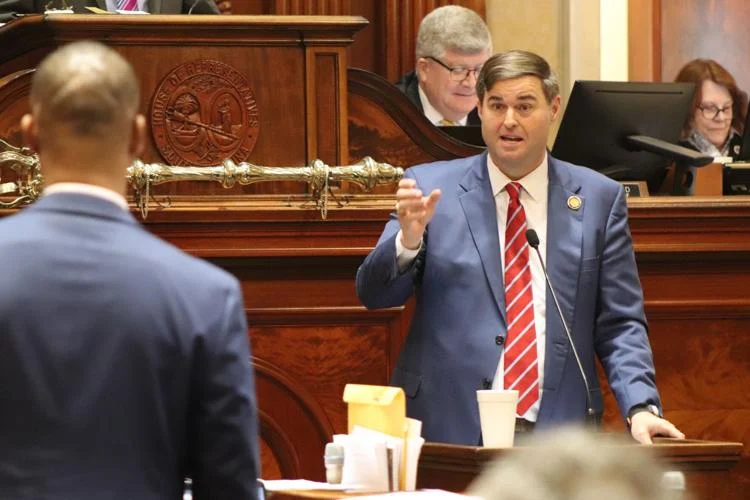
House Speaker Murrell Smith and House Majority Leader David Hiott announced plans Feb. 6 for proposals closely modeled on the initiatives pushed by Musk and Trump to downsize the bureaucracy and end government-sponsored practices supporting diversity, equity and inclusion, commonly known as DEI.
The anti-DEI bill, sponsored by Rep. Doug Gilliam, R-Buffalo, would model language in a recently implemented executive order from the president seeking to end “illegal discrimination” and “restore merit” in state and state contractors’ hiring, employment and training practices.
It would outlaw internal governmental policies boosting DEI, which opponents have characterized as a “failed experiment” in remarks to reporters, and would bar the state from contracting with external organizations that have their own DEI policies.
“I believe that what’s going on across this country, and to a certain extent in South Carolina, has gotten out of control,” Hiott, R-Pickens, told reporters.
“We hear tell of agencies that have formed a DEI program or a DEI office, and that their sole purpose is to make sure that kind of stuff is done, is taken care of,” he said. “That kind of stuff’s got to stop in South Carolina, and that’s what this bill is going to do.
“If you do business in South Carolina, you will not participate in DEI,” he added.
The group also announced a joint resolution with the Senate sponsored by Hiott and Sen. Stephen Goldfinch, R-Murrell’s Inlet, to set up a nine-member commission of non-legislators who Hiott said will “go out and do similar to what DOGE is doing,” a reference to the Department of Government Efficiency. Trump recast the United States Digital Service to create DOGE and put Musk in charge.
The proposal to create a commission bears similarities to a resolution sponsored earlier this session by Rep. Sylleste Davis, R-Moncks Corner. Three commission appointees selected by the House speaker, Senate president and the governor would review appropriations, regulations and government agencies that could be “eliminated, consolidated or otherwise restructured” to increase government efficiency.
“I think the beauty of a ‘DOGE’ is that you’re bringing people from outside government and having them to take a look at what’s going on in agencies, whether there are efficiencies to be had and whether there are savings to be had,” Smith told reporters. “That is what you need. You need an outsider approach because that’s a different analysis than an insider approach from legislators.”
Lawmakers offered few motivations for the effort beyond the larger cost-cutting campaigns at the federal level. Overall government spending in South Carolina has increased year after year, with McMaster’s proposed budget representing a 3.5 percent increase from last year. Additionally, the state has been run by Republicans for decades.
South Carolina has undertaken numerous government efficiency studies in the past, while the most recent effort — dubbed the House Government Efficiency and Legislative Oversight Committee — is still actively collecting public feedback to identify potential efficiencies in agencies like the Department of Insurance, the State Law Enforcement Division and the Department of Education.
Those reviews only occur every seven years and cover a handful of agencies. Smith told reporters the state equivalent of DOGE would be much more comprehensive, taking a look at everything. “We don’t have an Elon Musk in South Carolina,” Hiott said. “But it’ll be similar to what’s going on in Washington.”